Most Warm Leads Never Reply First. Here’s How Teams Catch Them Anyway
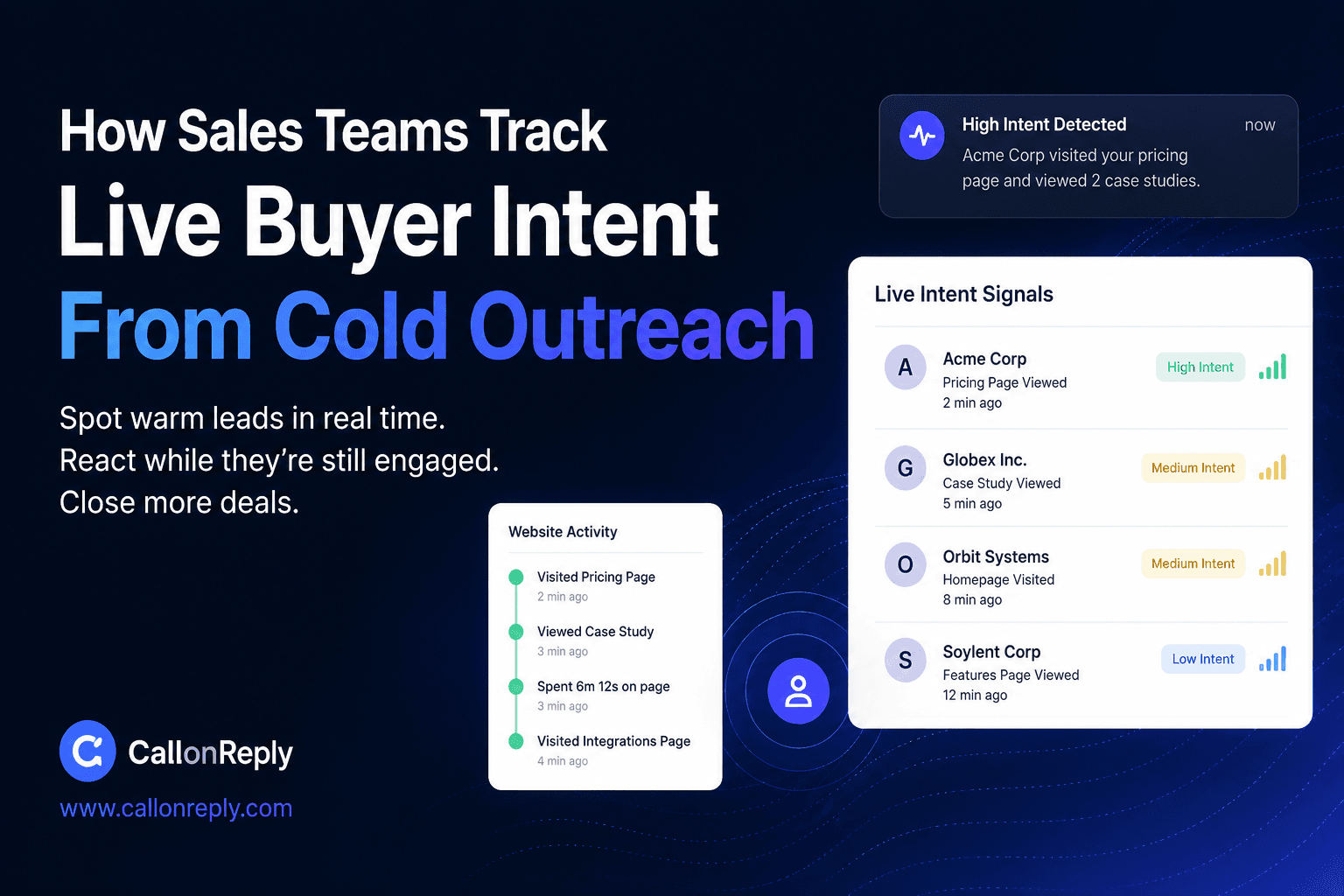
Most outbound teams have the same problem.
You send hundreds or thousands of cold emails every week, but the actual interesting leads get buried between auto replies, bounce notifications, spam warnings, and random noise.
At the same time, prospects are quietly visiting your website, checking pricing pages, reading case studies, and comparing solutions without ever replying to your email directly.
By the time you notice them, the momentum is already gone.
After years in outbound, this is honestly one of the biggest gaps I keep seeing in sales workflows. Teams spend enormous effort generating attention, but almost no effort detecting buying intent while it is happening.
That is exactly where live buyer intent tracking becomes useful.
What Is Live Buyer Intent Tracking?
Live buyer intent tracking means monitoring prospect behaviour in real time after outbound outreach.
Instead of waiting for someone to explicitly say “I’m interested,” you start looking at the signals people naturally leave behind while researching.
For example:
- revisiting your website multiple times
- checking your pricing page
- spending several minutes on case studies
- opening comparison pages
- returning after receiving a cold email
- clicking outreach links multiple times
None of these actions alone guarantee a deal.
But together, they tell a story.
Experienced sales reps already know this intuitively. The challenge is catching these moments fast enough to actually react to them.
Why Timing Matters More Than Most Teams Think
One thing I learned pretty quickly in outbound is this:
Warm leads cool down extremely fast.
A prospect who is actively researching your product right now behaves very differently from someone who visited your site yesterday evening and forgot about you this morning.
The timing window matters.
Especially for:
- agencies
- outbound SDR teams
- recruiters
- consultants
- high ticket B2B sales
The faster you react, the more natural the conversation feels.
That is why some of the best outbound operators obsess over speed to lead. Not because they enjoy chaos, but because intent fades quickly.
The Problem With Traditional Outbound Workflows
Most outbound workflows are reactive.
Teams usually:
- refresh inboxes manually
- monitor Slack notifications
- check campaign dashboards constantly
- search CRMs for activity
- rely only on direct replies
The problem is that buying intent often appears before the reply itself.
A prospect might:
- visit your pricing page three times
- forward your website internally
- compare integrations
- read customer stories
…without ever sending a message.
If nobody sees that activity, the opportunity stays invisible.
Website Behaviour Often Tells You More Than Replies
This is where website behaviour tracking becomes powerful.
In many cases, prospect behaviour reveals intent earlier than email replies do.
For example, imagine someone:
- clicks your outbound link
- visits your homepage
- leaves
- comes back later the same day
- opens the pricing page
- reads two case studies
- spends eight minutes on the website
That is not random browsing anymore.
Most experienced reps would want to know that immediately.
Especially if the lead details are already connected to the session.
The Real Advantage Is Context
The important part is not just getting notifications.
The real advantage is understanding why the signal matters.
If a sales rep receives:
- the company name
- the lead information
- pages visited
- session timing
- intent score
they can react with context instead of guessing.
That completely changes follow ups.
Instead of sending another generic email, you can approach the conversation knowing the lead is actively researching.
That creates much better timing.
Live Signals Change Prioritization
One thing outbound teams constantly struggle with is prioritization.
Every lead looks the same inside a spreadsheet.
But in reality, they are not the same at all.
Some prospects are completely cold.
Others are already halfway into a buying decision.
Live intent tracking helps separate those groups.
That becomes especially valuable at scale.
If a team is running:
- multiple inboxes
- several outbound campaigns
- LinkedIn outreach
- cold email sequences
…it becomes impossible to manually detect warm activity consistently.
The system has to surface the important signals automatically.
Why This Matters for Agencies
Agencies probably feel this pain the most.
Most agencies already:
- manage multiple inboxes
- run outbound for several clients
- monitor campaign performance constantly
- juggle different lead lists
Interesting replies and buying signals disappear very quickly in that environment.
Live intent tracking creates another layer of visibility.
Instead of relying only on open rates and reply rates, agencies can see:
- which leads are actively researching
- which companies revisit the website
- which campaigns generate real engagement
That makes optimization easier.
Mobile Notifications Matter More Than People Think
One thing we noticed very early is that desktop notifications alone are not enough.
Salespeople are not sitting inside dashboards all day.
They are:
- in meetings
- switching tabs
- traveling
- on calls
- working from phones
Getting a real time signal directly on mobile changes reaction speed significantly.
Especially when the notification already includes:
- lead details
- company information
- phone number
- intent context
At that point, reacting becomes frictionless.
Not Every Signal Should Trigger an Alert
This is important.
If every visitor triggers a notification, people stop trusting the system almost immediately.
Signal quality matters more than quantity.
The goal is not creating more noise.
The goal is filtering noise and surfacing the moments that actually deserve attention.
That is where AI intent analysis becomes useful.
Instead of simply tracking visits, the system can evaluate:
- visit frequency
- page combinations
- session depth
- timing patterns
- outbound attribution
Then decide whether the behaviour likely represents genuine buying intent.
Cold Email Replies Still Matter
Website behaviour is powerful, but inbox intent tracking still plays a huge role.
Most outbound inboxes are chaotic.
Good replies disappear constantly between:
- bounce notifications
- unsubscribe requests
- spam filter alerts
- automatic responses
AI based inbox monitoring helps detect:
- positive sentiment
- buying intent
- meeting interest
- urgency
…and surface those replies immediately.
Combined with website signals, this creates a much stronger outbound workflow.
The Future of Outbound Will Be Signal Driven
Outbound is changing.
The teams winning right now are not necessarily the teams sending the highest volume.
They are the teams reacting fastest to real intent.
That means:
- identifying engagement earlier
- prioritizing warmer accounts
- reducing response delays
- using behavioural data intelligently
Most buying intent already exists before the reply arrives.
The challenge is noticing it while the prospect is still engaged.